Basmati vs Non-Basmati Rice: A Buyer’s Guide for Global Importers basmati vs non basmati rice Product research
Basmati vs Non-Basmati Rice: A Buyer’s Guide for Global Importers
Rice buyers entering the Indian market often begin with a basic question: should they source Basmati or non-Basmati rice? Consequently, the distinction may sound straightforward, however, for an international importer, it affects much more than grain appearance.
Furthermore, product positioning, consumer expectations, cooking performance, packaging strategy, price sensitivity, destination-market demand, and supplier selection can all vary significantly between the two categories.
Undeniably, India is an important global source of both Basmati and non-Basmati rice. However, the right choice ultimately depends entirely on what the buyer is trying to achieve in the target market.
For example, a premium retail brand serving aroma-conscious consumers may certainly require a completely different product from a distributor supplying restaurants, institutional kitchens, wholesalers, or price-sensitive mass-market channels.
Therefore, this guide effectively explains the practical differences between basmati vs non basmati rice and strategically highlights the core questions global buyers should thoroughly consider before successfully placing an order.
Key Takeaway
Typically, Basmati is generally selected for premium positioning, distinctive aroma, long grains, and specific culinary applications. Conversely, non-Basmati rice covers a much broader range of varieties and may consequently be significantly better suited to everyday consumption, regional cuisines, foodservice, institutional demand, and cost-sensitive markets.
What Is Basmati Rice?
To begin with, Basmati is a distinctive category of aromatic long-grain rice traditionally deeply associated with specific geographic regions of the Indian subcontinent.
Specifically, it is widely recognised for exceptional characteristics such as:
- Furthermore, long, beautifully slender grains
- Additionally, a deeply distinctive natural aroma
- Moreover, notable grain elongation immediately after cooking
- Consequently, separate and relatively fluffy cooked grains when prepared correctly
- Ultimately, a strong enduring association with premium luxury rice consumption
Consequently, for international buyers, Basmati is certainly not simply “long-grain rice.” Instead, it is a highly regulated product category with particular market expectations actively surrounding variety, origin, aroma, ageing, grain dimensions, processing, and cooking performance. Therefore, common commercial discussions may directly include traditional or modern Basmati varieties, white rice, brown rice, raw rice, steam rice, and parboiled or sella formats. As a result, the exact terminology used in a commercial quotation should always be reviewed carefully.
Buyer Consideration
For instance, a quotation that says only “Basmati rice” may simply not provide nearly enough technical information for a serious sourcing decision. Therefore, buyers should strictly request the exact variety, precise processing type, specific grade parameters, detailed crop information where relevant, reliable packaging format, and firmly agreed quality specifications.
What Is Non-Basmati Rice?
Alternatively, non-Basmati rice is an incredibly broad commercial category consistently covering all rice varieties that are strictly not classified as Basmati. Consequently, this massive category can readily include:
- Moreover, long-grain, medium-grain, and short-grain rice
- Additionally, uniquely aromatic non-Basmati varieties
- Furthermore, affordable everyday consumption rice
- Subsequently, raw, heavily steamed, and effectively parboiled rice
- Finally, broken rice categories, strongly depending on the exact transaction and applicable trade conditions
Importantly, the general term “non-Basmati” absolutely does not describe one single uniform product. Indeed, that is undoubtedly one of the most vitally important points for global importers to clearly understand.
For example, two separate non-Basmati rice offers can easily differ substantially in grain length, finished texture, cooking behaviour, visual appearance, wholesale price, total broken percentage, residual moisture, processing method, and target retail application. Consequently, for this precise reason, astute buyers should rigorously avoid lazily treating non-Basmati rice as a single standardized commodity without a highly detailed specification.
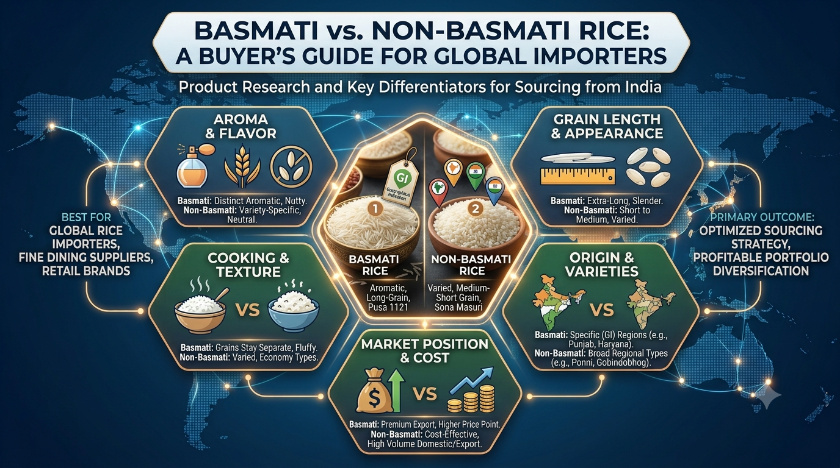
| Buying Factor | Basmati Rice | Non-Basmati Rice |
|---|---|---|
| Market Position | Often premium | Economy to mainstream, depending on variety |
| Aroma | Distinctive aromatic profile | Varies significantly by variety |
| Grain Shape | Typically long and slender | Long, medium, or short |
| Cooking Behaviour | Known for elongation and grain separation | Depends on variety and processing |
| Typical Demand | Premium retail, hospitality, speciality cuisine | Retail, wholesale, foodservice, institutional and mass-market use |
| Price Position | Generally higher | Often more price-flexible |
| Variety Range | Specific Basmati varieties | Very broad |
| Branding Potential | Strong premium positioning | Broad positioning from value to specialised segments |
| Best Choice For | Aroma-led and premium applications | Volume, versatility, regional preferences, and cost-sensitive channels |
Important: Furthermore, this comparison is strictly directional, and definitely not a direct substitute for a technical product specification. Ultimately, actual quality and performance consistently depend heavily on exact variety, crop, processing, milling, safe storage, traditional ageing, rigid supplier controls, and the firmly agreed contract parameters.
1. Grain Length and Appearance
Initially, one of the absolutely most highly visible structural differences between Basmati and non-Basmati rice is distinct grain morphology.
Basmati Rice
Generally, Basmati is typically deeply associated with very long, elegantly slender grains. Consequently, premium buyers rigorously evaluate characteristics such as exact average grain length, overall grain uniformity, pronounced slenderness, pristine appearance before cooking, impressive elongation after cooking, and the strict percentage of broken grains. As a result, visual consistency is particularly critically important for high-end premium retail packs and discerning hospitality buyers.
Non-Basmati Rice
On the other hand, non-Basmati rice can vary massively from long and beautifully slender to much thicker medium or short-grain formats. Therefore, this clearly means a buyer should absolutely never incorrectly assume that “non-Basmati” automatically means short or low-grade rice. Indeed, certain non-Basmati varieties experience incredibly strong commercial demand because they perfectly match highly specific regional cooking preferences or strict wholesale price points.
Buyer question: Specifically, what exact grain profile does the destination market actually truly prefer? Ultimately, that crucial answer should absolutely come long before arbitrary variety selection. Furthermore, for highly actionable insights into successfully finding proper trading channels, view our comprehensive guide on how to find a reliable agro products supplier in India.
2. Aroma and Sensory Profile
Undoubtedly, aroma is definitely one of Basmati rice’s remarkably strongest commercial differentiators. Consequently, for lucrative markets where consumers strongly associate premium luxury rice with wonderful fragrance and cherished traditional dishes, Basmati can seamlessly support a significantly higher-value product proposition. However, aroma should certainly not be lazily assessed only through glowing marketing language. Instead, astute buyers may essentially need to deeply consider the exact variety, distinct crop characteristics, proper storage, traditional ageing, the precise processing method, empirical sample performance, and unyielding consistency across multiple shipments.
Meanwhile, non-Basmati rice naturally has a much wider, more diverse sensory range. For example, some non-Basmati varieties are relatively perfectly neutral, while others proudly possess their own uniquely distinctive characteristics. Ultimately, for intelligent importers, the truly important question is certainly not simply which rice is broadly “more aromatic.” Rather, it is verifying whether the sensory profile flawlessly matches strict local consumer expectations.
3. Cooking Performance
Furthermore, cooking behaviour is undeniably a massive commercial factor, especially for fast-paced foodservice, hospitality, catering, restaurant, and large private-label buyers.
Basmati Rice May Be Preferred When:
- Moreover, grain elongation is crucially important
- Additionally, separate, un-clumped cooked grains are highly expected
- Furthermore, aroma wonderfully contributes to the dish
- Consequently, the target cuisine deeply values long-grain presentation
- Finally, premium, flawless serving quality absolutely matters
Non-Basmati Rice May Be Preferred When:
- Conversely, a softer, stickier texture is heavily desired
- Alternatively, the local cuisine firmly requires a different grain structure
- Furthermore, everyday mass affordability really matters
- Moreover, institutional supply volume is critically important
- Ultimately, the end application genuinely does not require premium aromatic positioning
Practical Buyer Tip
First, always rigorously test samples using exactly the actual commercial cooking method heavily used in the destination market. Although laboratory specifications are undeniably important, real-world cooking trials can vividly reveal massive differences in actual water absorption, cooked texture, residual stickiness, grain separation, final aroma, and holding performance.
4. Price and Commercial Positioning
Admittedly, price is often a major reason buyers fiercely compare Basmati and non-Basmati rice, but the absolute cheapest quotation is certainly not always the lowest-cost long-term sourcing decision. Typically, Basmati rice generally occupies a significantly higher price segment fundamentally because of specific variety, premium market positioning, strict quality expectations, traditional ageing requirements, careful processing, and massive branding potential.
Conversely, non-Basmati rice often effortlessly provides far greater flexibility for massive high-volume distribution, mass-market retail, large institutional supply, wholesale channels, and highly price-sensitive consumer segments. Therefore, buyers should absolutely compare quotations strictly on a fully like-for-like basis. For instance, a significantly lower quoted price may merely reflect hidden differences in a higher broken percentage, dangerous moisture, poor grain uniformity, cheap processing, flimsy packaging, weak inspection terms, unfavourable Incoterms, smaller shipment size, or ignored destination requirements.
Commercial Warning
Therefore, absolutely do not lazily compare two rice offers only by raw price per metric tonne. Consequently, first standardise the exact specification, robust packaging, trade term, independent inspection requirement, shipment quantity, and destination legal conditions.
5. Processing Type Matters
Moreover, the standard Basmati vs non-Basmati comparison is actually only one initial layer of comprehensive product selection. Consequently, buyers may also urgently need to choose between entirely different processing formats:
- Raw Rice: Specifically, this is rice that has been carefully milled completely without a hydrothermal parboiling process. Consequently, cooking characteristics depend heavily on the exact variety and milling quality.
- Steam Rice: Additionally, steam processing can heavily influence grain behaviour, structural strength, and final cooking characteristics.
- Parboiled Rice: Meanwhile, parboiling firmly involves intense hydrothermal processing long before milling. Consequently, depending heavily on the exact product and market, it may be frequently selected for specific resilient cooking performance and commercial applications.
- Sella Rice: Furthermore, this term is commonly encountered in the active rice trade, particularly in Basmati-related offers. Therefore, buyers should strictly confirm the exact processing method and product specification rather than blindly relying only on the commercial marketing label.
Buyer rule: Ultimately, never assume that two distinct products with similar-sounding names will automatically cook identically. Moreover, for broader context on booming Indian agricultural exports, see our detailed review of the top agricultural products exported from India.
6. Typical Market Applications
Ultimately, the single best rice category depends incredibly heavily on the target sales channel.
Premium Retail
Specifically, Basmati may be highly suitable where consumers strongly recognise the luxury category, sweet aroma is a massive selling point, premium packaging is commercially viable, and verified origin/variety actively support elite brand positioning.
Restaurants and Hospitality
Naturally, the purchasing decision depends entirely on specific cuisine and strict menu requirements. For example, Basmati may be strongly preferred for luxurious dishes where elegant long-grain presentation and captivating aroma matter immensely. Conversely, non-Basmati varieties may be vastly more appropriate for authentic regional cuisines requiring different textures or for massive high-volume operations with incredibly strict food-cost targets.
Wholesale Distribution
Furthermore, wholesalers may frequently need multiple distinct grades or diverse varieties to successfully serve completely different regional customer groups. As a result, a diversified portfolio approach can naturally be much more commercially effective than stubbornly choosing one single rice category for absolutely every buyer.
Institutional Supply
Similarly, large institutional kitchens, massive catering operations, and government buyers may heavily prioritise absolute consistency, high volume yield, cooking stability, low price, flawless supply continuity, and sheer packaging efficiency. Consequently, in these rigorous cases, the absolute most premium product is certainly not automatically the most commercially suitable choice.
7. Quality Specifications Global Rice Buyers Should Check
Regardless of whether sourcing aromatic Basmati or high-volume non-Basmati rice, buyers should definitively define strictly measurable parameters long before officially confirming an order. Specifically, a highly practical specification sheet may crucially include:
- Moreover, exact rice variety and precise processing type
- Additionally, guaranteed average grain length and strict broken percentage limits
- Furthermore, maximum moisture level and strict foreign matter limits
- Consequently, damaged, chalky, or discoloured grain tolerances
- Furthermore, exact crop year, specific milling degree, and modern sortex/cleaning expectations
- Subsequently, approved packaging type, exact net weight, and rigid labelling requirements
- Finally, third-party inspection terms and strict destination-market compliance requirements
Buyer Checklist: Before Comparing Rice Quotations
Consequently, ensure all vital commercial variables are accounted for before finalizing binding contract terms:
8. Packaging Options for International Buyers
Undeniably, packaging is absolutely not a trivial secondary decision. In fact, it massively affects shipping logistics, retail shelf positioning, vital product protection, and the total final landed cost. For instance, common commercial formats include stand-up retail pouches, durable woven polypropylene bags, heavy-duty laminated bags, massive bulk sacks, and completely customized private-label packaging.
Consequently, a premium Basmati brand may heavily require much stronger visual presentation and attractive consumer-facing configurations, while a massive wholesale non-Basmati order may simply prioritise sheer durability, rapid handling efficiency, and rock-bottom cost. Therefore, buyers should explicitly confirm all packaging materials, strict net weight tolerances, graphic artwork responsibilities, exact printing methods, mandatory barcode/language needs, vital importer information, realistic production lead times, and secure palletisation where required.
9. Destination-Market Requirements
Importantly, rice import legal requirements vary wildly by destination country and may frequently change abruptly over time. Consequently, long before shipment, vigilant buyers must thoroughly verify highly applicable requirements related specifically to strict food safety, tight pesticide residue limits (MRLs), dangerous contaminants, mandatory phytosanitary documentation, origin certificates, rigid labelling laws, precise customs classification, and strict product-specific restrictions.
While the supplier should certainly be able to intelligently discuss required documentation and smooth export processes, nevertheless, the importer should independently verify current, updated destination-country requirements directly with the relevant health authorities and highly qualified trade professionals.
Important Consideration: Indeed, a given rice product being seamlessly exportable from India absolutely does not automatically mean it legally satisfies every strict sanitary or regulatory requirement mandated in the destination country.
10. How to Choose Between Basmati and Non-Basmati Rice
Ultimately, the entire decision becomes dramatically easier when buyers actively start with the actual target market rather than lazily browsing the supplier catalogue.
Choose Basmati When:
- Moreover, premium luxury positioning is important and consumers deeply value aroma
- Furthermore, elegant long-grain presentation absolutely matters for the specific target cuisine
- Consequently, elite brand differentiation actively supports a significantly higher retail price point
Consider Non-Basmati When:
- Alternatively, mass affordability and high-volume distribution are the main commercial priorities
- Furthermore, the local target market strongly prefers a completely different texture (like medium or short grains)
- Moreover, large institutional or massive foodservice applications heavily dominate the purchase order
- Consequently, much broader price segmentation is heavily required across your vast distribution channels
Consequently, in some highly diverse markets, the absolute best strategy often involves intelligently importing both distinct categories to perfectly serve completely different customer segments.
11. Questions to Ask an Indian Rice Supplier
Before finalising any major order, always clear up lingering ambiguities by actively asking highly specific technical questions:
- Firstly, which exact rice variety are you offering?
- Furthermore, has the rice been processed as raw, steamed, parboiled, or another specified processing type?
- Could you please provide the precise grain-length parameters?
- Additionally, which broken percentage is strictly guaranteed under this contract?
- How much moisture tolerance legally applies to this specific batch?
- Moreover, would you please provide a representative sample from the current milling batch?
- Are there specific packaging formats and custom private-label options readily available?
- Consequently, which exact export documentation can you reliably provide for my target port?
- Also, could you clarify which Incoterms precisely apply to this quotation, and specify the minimum order quantity?
- Please specify the exact expected production and subsequent shipment lead time?
- Furthermore, is it possible that independent pre-shipment inspection can be arranged directly at the facility?
- Finally, by what exact methods do you rigorously maintain quality consistency across repeat volume orders?
12. Common Mistakes Global Rice Buyers Should Avoid
- Firstly, Choosing by Price Alone: A suspiciously low price may easily hide severe deficiencies in specifications, extremely poor packaging, a radically higher broken percentage, or completely unviable delivery terms.
- Secondly, Using Vague Product Names: General terms like “Premium rice” and “long-grain rice” are merely fuzzy marketing labels, and certainly not sufficient technical terms.
- Additionally, Skipping Sample Evaluation: A basic printed specification sheet definitely cannot fully demonstrate highly practical cooking behaviour or actual aroma release.
- Furthermore, Ignoring the End Consumer: The truly right rice firmly depends entirely on exactly how end consumers in the actual destination market cook and ultimately consume it.
- Moreover, Assuming Every Shipment Matches the First Sample: True repeat-order consistency must absolutely be formally discussed, legally agreed upon, and continuously monitored.
- Subsequently, Overlooking Packaging Costs: Highly custom retail graphics and incredibly robust multi-layer bags can massively and materially alter the final landed cost calculation.
- Finally, Failing to Verify Import Requirements: Simple documentation mistakes constantly cause agonizing delays, brutal demurrage fees, and devastating custom rejections at destination ports.
Basmati vs Non-Basmati Rice: Which Is Better?
Ultimately, neither category is universally better.
Specifically, Basmati may undeniably be the vastly stronger choice for premium, aroma-led, luxurious long-grain applications and lucrative markets where consumers instantly recognise its distinctive characteristics. Alternatively, non-Basmati rice may absolutely be better for massive high-volume channels, affordable everyday consumption, specific regional cuisine preferences, huge institutional demand, and volatile markets where sheer price flexibility is totally essential.
Consequently, the truly right sourcing decision definitively depends on these five questions:
- First, exactly who is the final end customer?
- Second, precisely how will the rice ultimately be cooked?
- Third, exactly what specific price segment is actively being targeted?
- Fourth, precisely what quality parameters are genuinely essential?
- Finally, exactly what legal rules does the destination market rigidly require?
As a result, a meticulous buyer who definitively answers these questions long before requesting initial quotations is exponentially more likely to compare highly relevant products and easily avoid completely unsuitable offers.
Source Rice from India with a Clear Buyer Specification
Furthermore, at IIMCL, we robustly support international buyers actively exploring lucrative sourcing opportunities across Indian agro products and various other booming business categories. Specifically, for rice sourcing enquiries, the entire process should strictly begin with a perfectly clear understanding of the buyer’s requirement, heavily including target rice category, exactly preferred variety, required processing type, strict quality expectations, exact packaging format, total order quantity, final destination country, and rigid commercial requirements.
Consequently, whether you are evaluating aromatic Basmati or high-volume non-Basmati rice, a highly structured sourcing process can massively help powerfully reduce ambiguity and vastly improve supplier discussions. Therefore, you can easily view our options on our product or shop page, actively explore our dedicated Agro Products section, or reach out to us directly through the Contact Us page to safely share your precise commercial specifications.
In conclusion, if you are looking for reliable rice sourcing support from India, simply share your exact product requirements, precise target market, specific packaging needs, total expected quantity, and final destination country with the IIMCL team to rapidly begin a significantly more focused sourcing discussion.
Frequently Asked Questions
What is the primary difference between Basmati and non-Basmati rice?
Specifically, Basmati rice is a highly specific category of aromatic long-grain rice strictly defined by its truly distinctive fragrance, elegantly slender shape, and unique grain elongation when cooked. Alternatively, non-Basmati rice is a massive, broad catch-all category effectively covering absolutely all other rice varieties, which can easily range from short to long grains and generally completely lack the characteristic sweet aroma of Basmati.
Why is Basmati rice more expensive than non-Basmati varieties?
Consequently, Basmati rice generally commands a significantly higher price firmly because of its luxurious premium positioning, strictly specific geographic cultivation zones, inherent yield limitations, highly extensive processing, and the meticulous traditional ageing requirements absolutely needed to perfectly develop its optimal aroma and cooking traits.
What processing options apply to Indian rice exports?
Furthermore, buyers can seamlessly choose from several processing formats heavily depending on their specific commercial needs, absolutely including raw milled rice, steam processed rice, hydrothermally parboiled rice, and resilient sella rice (a specific type of parboiling widely used in the Basmati trade to greatly toughen grains against breaking).
Can I use a low price per tonne to compare different rice suppliers?
Absolutely no. Consequently, comparing multiple rice offers purely by raw unit cost entirely without firmly fixing strict quality parameters is a devastating mistake. For instance, a significantly cheaper quote almost always indicates a much higher broken percentage, dangerous greater moisture content, a completely different crop year, terribly basic packaging, or vastly less inclusive Incoterms.
How can I verify if an import batch will clear my country’s customs?
Ultimately, importers should independently verify all current, updated local entry laws directly with qualified trade professionals or licensed customs brokers. Specifically, key critical areas to check definitely include officially approved pesticide maximum residue limits (MRLs), strict specific phytosanitary certification requirements, and rigid mandatory packaging label data.
Discuss Your Rice Sourcing Requirement
Consequently, whether you require a highly premium aromatic Basmati variant for elite retail distribution or a massive, cost-flexible non-Basmati grade for institutional supply, a fully secure trade always strictly begins with an explicit, detailed procurement breakdown.