How to Choose a Reliable Healthcare Products Supplier for International Markets
How to Choose a Reliable Healthcare Products Supplier for International Markets
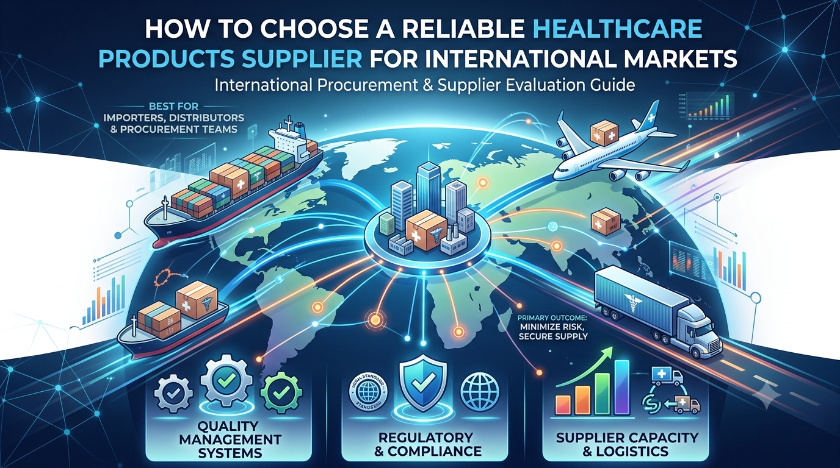
Notably, strategic risk parameters, quality management systems documentation, and regulatory operational matrices are essential for international procurement selection.
Importers, distributors and procurement teams
Quality, documentation, compliance and capacity
A stronger supplier shortlist
To begin with, choosing a healthcare products supplier for international markets requires significantly more effort than comparing catalogues and requesting the lowest quotation. Consequently, healthcare procurement can involve products with entirely different technical specifications, intended uses, quality requirements, storage conditions, shelf lives, regulatory classifications, and destination-market obligations. For example, a supplier that appears suitable during an initial sales conversation may not necessarily be prepared to support the complete international transaction.
Therefore, for importers, distributors, hospital procurement teams, institutional buyers, and healthcare businesses, the real question is not simply: “Can this company supply the product?” Instead, a much stronger question is: “Can this supplier support the exact product requirement, documentation expectations, quality process, commercial terms, and destination-market needs of this transaction?” Undoubtedly, that difference matters immensely.
Ultimately, a reliable supplier should always be evaluated strictly against the actual product and market involved. Furthermore, this comprehensive evaluation process may include business verification, product specification review, regulatory assessment, quality documentation, manufacturing transparency, packaging, shelf life, logistics, communication, and post-supply support. In addition, businesses exploring relevant product and sourcing opportunities can easily review IIMCL’s Healthcare Solutions division.
Why Healthcare Supplier Selection Requires Greater Care
Admittedly, not all healthcare products carry the same level of complexity or risk. Specifically, the broad healthcare market can include pharmaceutical products, medical devices, in-vitro diagnostics, medical consumables, hospital-use products, laboratory-related products, healthcare accessories, wellness products, and other specialized categories. As a result, each distinct category may naturally involve entirely different procurement requirements.
Evaluating Specific Sourcing Risk Factors
For instance, the procurement process for a general hospital-use item may differ significantly from the process for a highly regulated medical device. Similarly, a pharmaceutical product may involve very different documentation and market-authorization questions compared to a simple non-drug healthcare accessory. Therefore, supplier evaluation should always be strictly proportionate to:
- The exact product & technical profile
- Intended medical or clinical use
- Regulatory classification frameworks
- Patient or user risk matrices
- Destination market mandates
- Total commercial order value
- Internal enterprise procurement policies
Consequently, the exact same checklist should never be applied blindly to every healthcare product. Hence, this is one major reason why experienced international buyers should always begin with strict product definition before starting any supplier comparison.
The 16-Step Supplier Evaluation Process
Furthermore, a structured step-by-step pathway allows procurement groups to evaluate vendor operational capacity objectively, thereby preventing premature price data from dominating the selection cycle.
Phase 1: Initial Discovery and Identification
First and foremost, a reliable supplier search always begins with a precise requirement. Specifically, avoid weak enquiries like: “We need medical products for export. Send catalogue.” Instead, construct a stronger profile covering exact nomenclature, components, parameters, expected volumes, target destination, and required shelf life.
Next, determine exactly where the firm operates within the value loop, whether as a manufacturer, exporter, distributor, or trading intermediary. Indeed, explicit transparency regarding who owns the brand and who issues technical paperwork forms a commercially coherent picture.
Furthermore, confirm registration numbers, legal entity status, matching physical sites, and digital communication networks. For example, regarding Indian international trade, the DGFT IEC Profile Management portal allows buyers to review basic Importer-Exporter Code structural details. Importantly, note that an IEC is a foundational identification asset, rather than complete operational or quality verification.
Subsequently, ensure clear lineage directly back to the original factory site. Specifically, if an exporter coordinates the trade, ensure that the certifications, testing protocols, and packaging configurations align perfectly with the specific product models currently on offer.
Phase 2: Regulatory Compliance and Quality Assurance
Most importantly, move past vague inquiries regarding broad organizational certifications. To illustrate, verify the specific medical classification tier, licence history, validity dates, and regulatory ownership. For instance, for device components, the Central Drugs Standard Control Organisation (CDSCO) provides dedicated medical-device resources and simultaneously handles the Medical Devices Rules framework.
Additionally, a supplier’s localized compliance within India certainly does not guarantee market entry into overseas jurisdictions. Consequently, importer licences, language translations, local representative nodes, and customs entry codes must be cleared directly with the target country’s authorities. Ultimately, marketing phrases like “export quality” absolutely do not replace formal regulatory approval.
Similarly, examine how the entity monitors incoming raw materials, batch consistency, testing protocols, and non-conformance deviations. For example, organizations like the World Health Organization (WHO) deploy clear guidelines within their quality-assurance policy metrics for health product procurement, consistently emphasizing structured evidence over generic sales claims.
Specifically, verify that technical data sheets, sterilization validation data, certificates of analysis, and user manuals are entirely current, legible, and directly tied to the correct manufacturing site address.
Phase 3: Production Capability and Technical Verification
Therefore, never accept a graphic file or website emblem as definitive validation. Instead, actively cross-check certificate numbers, issuer credentials, coverage scopes, and expiration windows directly against official registrar directories.
Meanwhile, strictly verify minimum order thresholds, production timelines, surge margins, and source raw material dependencies. Furthermore, ensure the operation can comfortably support recurring orders without any structural quality degradation across multiple cycles.
For instance, utilize physical product runs to tangibly verify tactile materials, dimensional profiles, and basic structural design. Importantly, always remember that a baseline sample does not substitute for written specifications, factory validation files, or batch test reports.
In addition, carefully review unit box dimensions, outer carton structural strength, language scripts, clear placement for expiration data, lot track bars, and specialized barriers needed to protect fragile elements or maintain sterility.
Phase 4: Commercial Alignment and Ongoing Support
Crucially, examine exact stability parameters, temperature limits, and humidity tolerances strictly alongside shipping lead times. Because, a product that seemingly retains regulatory efficacy may completely fail commercially if transit and port processes exhaust its required shelf life for institutional tenders.
Subsequently, thoroughly normalize financial proposals. Specifically, compare identical material compositions, standardized Incoterms positions, identical testing inclusions, and clear packaging allocations to systematically prevent cheap, uncompliant alternatives from causing downstream issues.
Moreover, closely track technical accuracy, clarity in answering design changes, timeline commitments, and immediate documentation processing. Consequently, sudden reluctance to answer technical questions serves as a clear warning indicator.
Finally, firmly establish accountability lines for future lot investigations, adverse incident response patterns, tracking protocols, and direct commercial liabilities long before the final contract signature is finalized.
Manufacturer vs Exporter vs Distributor: Supply Chain Typology
Admittedly, there is no single universally preferred partner model. Ultimately, selection depends entirely on specific enterprise requirements, target volume limits, and required product variety.
Buying from a Manufacturer
Advantages: On one hand, buying from a manufacturer provides direct technical loops, explicit visibility over the factory layout, and clear design iteration potential.
Limitations: Conversely, this often involves high minimum order boundaries, restricted product variations, and limited localized logistics handling options.
Buying from an Exporter
Advantages: Alternatively, buying from an exporter offers strong international trade compliance management, mixed shipping consolidation options, and multiple category access.
Verification Needs: However, this absolutely requires explicit tracking back to target manufacturing hubs and fully authenticated documentation lineages.
Buying from a Distributor
Advantages: On the other hand, buying from a distributor yields lower order volume minimums, immediate ready stock access patterns, and rapid cross-brand aggregation models.
Verification Needs: Consequently, buyers must demand chain of authorization verification and direct factory recall operational linkages.
Technical Document Verification Matrix
Specifically, use this standardized checklist during document verification phases to continually confirm structural file completeness.
Common Red Flags When Choosing a Healthcare Products Supplier
Undoubtedly, no single warning sign automatically proves that a company is completely unreliable. However, unexplained inconsistencies should always trigger immediate further verification. Therefore, specific potential red flags include:
- Refusal to identify the manufacturer or physical factory location parameters
- Certificates completely unrelated to the specific product configuration under review
- Expired certificates or mismatched corporate entities across commercial documentation
- Unexplained beneficiary changes or variations in banking destination entries
- Unrealistic regulatory approval claims or promises that one certificate permits sale worldwide
- Inability to provide clear, written specifications or transparent shelf-life stability information
- Inconsistent packaging configuration files or no clear product classification pathways
- Pressure for immediate payment paired with quotations significantly below comparable market offers
- Unwillingness to explicitly document important quality or complaint-handling terms
A 15-Point Healthcare Supplier Evaluation Scorecard
Implementation Strategy
First, before shortlisting, score candidate vendors systematically across these fifteen core pillars. Consequently, use a disciplined scale: 0 = Not demonstrated | 1 = Partially demonstrated | 2 = Clearly demonstrated (Maximum score: 30 points).
| Scorecard Metric | Evaluation Dimension | Target Objective |
|---|---|---|
| 1. Business Identity | Corporate Verification | Is the legal business entity clearly identifiable across data networks? |
| 2. Supplier Role | Supply Chain Position | Is the corporate position in the value chain explicit and clear? |
| 3. Manufacturer Link | Origin Transparency | Is the actual manufacturing facility explicitly known and verified? |
| 4. Product Definition | Item Clarification | Is the exact technical configuration fully distinguished? |
| 5. Specification Match | Requirement Alignment | Does the product profile meet the buyer’s technical sheet? |
| 6. Regulatory Relevance | Licensing Scope | Are the certifications specific, valid, and unexpired? |
| 7. Destination Readiness | Import Clearance Focus | Has the entry procedure for the target country been evaluated? |
| 8. Documentation | Dossier Completeness | Are the technical data files authentic and consistent? |
| 9. Quality Approach | Process Enforcement | Is there a credible, product-appropriate quality tracking workflow? |
| 10. Supply Capacity | Volume Capability | Can the entity reliably meet programmatic order scales? |
| 11. Packaging Layouts | Configuration Control | Are labeling elements compliant with destination market safety laws? |
| 12. Shelf Life Parameters | Stability Tracking | Are expiration dates viable for international maritime transit lines? |
| 13. Commercial Clarity | Contract Stability | Are target pricing, MOQs, Incoterms, and schedules finalized? |
| 14. Communication Stream | Technical Transparency | Are technical explanations direct, complete, and reliable? |
| 15. Post-Supply Support | Accountability Matrix | Are there explicit processes for processing future lot discrepancies? |
How to Build a Supplier Shortlist
Rather than immediately choosing one company, consider creating a highly structured shortlist. Because, using a staged selection approach is highly beneficial as it predictably prevents a suspiciously low quotation from dominating the final procurement decision too early.
- Stage 1: Initial Screening: Initially, review basic business identity, baseline category availability, macro capability, and target market relevance.
- Stage 2: Technical Review: Following this, compare exact specifications, material compositions, intended uses, device classification, and manufacturer details.
- Stage 3: Commercial Review: Thereafter, compare exact volumes, unit pricing profiles, packaging configurations, production lead times, and underlying delivery basis terms.
- Stage 4: Risk Review: Subsequently, evaluate systemic documentation inconsistencies, vendor transparency gaps, destination regulatory hurdles, and logistics dependencies.
- Stage 5: Final Approval: Ultimately, execute sample inspections, verify third-party test records, perform site reviews or audits if necessary, and finally formalize contract terms.
Balancing Commercial Pricing and Long-Term Value
Admittedly, price certainly matters for international procurement teams who continuously manage strict budgets, tight margin targets, and intense competitive pressures. However, the remarkably lowest initial quotation frequently becomes very expensive when unforeseen problems involve specification mismatch, rejected goods, inadequate documentation, or sudden regulatory delays. Furthermore, unexpected shipment problems, dangerously inconsistent quality, or poor complaint handling can heavily disrupt your workflow. Therefore, a notably lower price profile is truly valuable only when the overall operational offer remains completely compliant.
How IIMCL Supports Healthcare Product Enquiries
Historically, India International Marketing Centre Limited has extensive business experience dating back to 1993 and reliably operates across multiple business divisions, including Healthcare Solutions. To achieve optimal results, international buyers approaching IIMCL should absolutely provide a clear and detailed requirement wherever possible. For instance, highly useful information includes: exact healthcare product, intended use, specification, model or reference, required quantity, packaging, destination country, destination port, required timeline, applicable documentation expectations, and relevant market requirements.
As a result, this exact descriptive information significantly helps the relevant team thoroughly understand the enquiry and carefully assess appropriate next steps. Furthermore, buyers can easily explore IIMCL’s Healthcare Solutions division for more information about highly relevant business capabilities. Alternatively, international buyers currently researching broader sourcing opportunities can also browse IIMCL’s product categories. Finally, for a specific requirement, buyers can contact IIMCL directly with a detailed healthcare product enquiry.
Frequently Asked Questions
Strategic Procurement Questions
How do I choose a reliable healthcare products supplier?
First, begin with an exact product requirement. Next, systematically evaluate the supplier’s business identity, role, manufacturer transparency, product specification, relevant regulatory information, documentation, quality approach, capacity, packaging, shelf life, commercial terms, communication, and post-supply support.
Is buying directly from a manufacturer always better?
Certainly not. While a manufacturer may logically provide direct technical access, conversely, an exporter or distributor may alternatively offer broader sourcing, smaller quantities, or stronger international coordination. Consequently, the right structure depends fully on the transaction. Ultimately, verifiable transparency and true capability matter far more than the supplier label alone.
What documents should I request from a healthcare supplier?
Specifically, the entirely correct documents depend strongly on the product and destination market. For instance, they may prominently include specifications, technical data, test reports, quality certificates, manufacturing information, shelf-life information, registration details, labelling, or other highly product-specific records.
Documentation and Compliance Queries
How can I verify a supplier’s certificates?
First, thoroughly review the issuing body, certificate number, company name, site address, scope, issue date, expiry date, and actual product relevance. Subsequently, wherever possible, strictly use the issuing organization’s official online verification process. Above all, do not treat a simple logo on a website as acceptable proof.
Does an Indian IEC prove that a supplier is reliable?
Indeed no. Although the IEC is undoubtedly an important import-export business identification number within India’s trade framework, however, it absolutely does not by itself prove product quality, regulatory compliance, factory capacity, or long-term commercial reliability.
Should I choose the supplier with the lowest quotation?
Definitely not automatically. Instead, first confirm precisely that all quotations confidently cover equivalent products, identical specifications, matching quantities, correct packaging, safe shelf life, verifiable documentation, equal delivery terms, and acceptable lead times.
How important are destination-country regulations?
Undeniably, they can be entirely critical. Because a product’s specific approval status in India does not automatically authorize legal import or sale in another country. Therefore, buyers should independently verify all applicable requirements directly with the relevant destination-market authority.
Can IIMCL support international healthcare product enquiries?
Certainly, international buyers can easily submit your specific healthcare product requirement including the exact product, technical specification, volume quantity, safe packaging, final destination, timeline, and relevant documentation expectations. Subsequently, the appropriate IIMCL team can then carefully review the information provided.
Industry Export Context: Furthermore, according to historical trade data tracks from Pharmexcil, India’s drugs and pharmaceutical exports reached approximately US$30.46 billion in fiscal year 2024-25, thereby highlighting the country’s foundational role within international healthcare supply streams.
Evaluating a Healthcare Products Supplier for Your Market?
Consequently, a strong supplier decision always begins with a clear product requirement and a highly structured evaluation process. Therefore, if your organization is actively sourcing healthcare products for international distribution, institutional procurement, wholesale supply, or another critical B2B requirement, confidently share the exact parameters with IIMCL to systematically establish a reliable sourcing framework.