How to Source Pulses from India: Guide for Importers and Distributors
How to Source Pulses from India: Guide for Importers and Distributors
Sourcing pulses from India can create valuable opportunities for international importers, wholesalers, food distributors, retailers, and private-label businesses. However, a successful transaction requires more than finding a supplier offering an attractive price.
Pulses are traded across different varieties, grades, processing formats, origins, crop conditions, packaging options, and quality specifications. Two quotations for what appears to be the same product may represent materially different commercial offers.
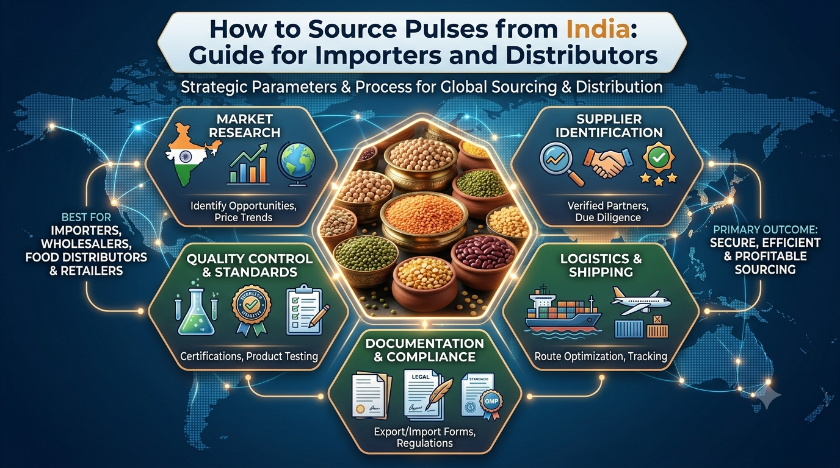
For global buyers, the sourcing process should begin with a clear product requirement and continue through supplier evaluation, sample approval, specification alignment, commercial comparison, inspection planning, documentation, and shipment control. This guide explains how importers and distributors can approach pulse sourcing from India in a more structured way.
Key Takeaway
Successful pulse sourcing starts with a precise buyer specification. Define the exact product, quality parameters, processing format, packaging, quantity, destination, and commercial terms before comparing suppliers.
Why International Buyers Source Pulses from India
India has a large and diverse agricultural and food-processing ecosystem. For international buyers, this can provide access to multiple pulse and pulse-related product categories, processing capabilities, packaging formats, and supplier types.
Depending on the product and transaction, buyers may explore sourcing opportunities across categories such as chickpeas, pigeon peas, lentils, mung beans, urad or black gram, whole or split formats, and polished or unpolished variations.
The commercial opportunity, however, varies by product. Availability, export conditions, domestic demand, crop cycles, government policy, quality, and pricing can change. Importers should therefore verify current conditions for the exact product before making commitments.
Importer Note
Do not assume that every pulse widely produced or consumed in India is automatically available for unrestricted export at all times. Product-specific trade conditions should be checked during the sourcing process.
Step 1: Define the Exact Pulse You Want to Source
The first sourcing mistake often happens before a supplier is contacted. A buyer requests a broad product such as: “Need chickpeas.” That is not enough information for a reliable quotation. A serious request should identify the exact product parameters clearly, including the local trade name, split/whole format, size or count, and target grade.
Buyer Example
Instead of asking for “best quality pulses,” prepare an enquiry around a defined product, measurable quality requirements, packaging format, order quantity, destination port, and preferred Incoterm.
Step 2: Understand the Main Pulse Categories
Importers should understand the commercial differences between pulse products before requesting prices from an Indian provider.
Chickpeas
Chickpeas can serve retail, wholesale, foodservice, processing, and private-label markets. Buyer requirements differ according to seed size, count, colour uniformity, moisture, and foreign matter limits.
Pigeon Peas
Pigeon peas are important in several global food markets and may be traded in whole or processed forms. Importers should confirm processing levels, colour expectations, and broken material tolerances.
Mung Beans
Mung beans may be purchased for direct consumption, processing, or sprouting. The intended use matters significantly because a product suitable for processing may not meet sprouting metrics.
Urad or Black Gram
Commercial requirements differ depending on whether the buyer requires a whole product, a split layout, a skin-on format, or a completely dehusked configuration.
Lentils and Other Pulse Products
The broader pulse market includes multiple products and formats where trade names vary between countries. Buyers should align the commercial name, botanical identity, physical sample, and technical specification before confirming an order.
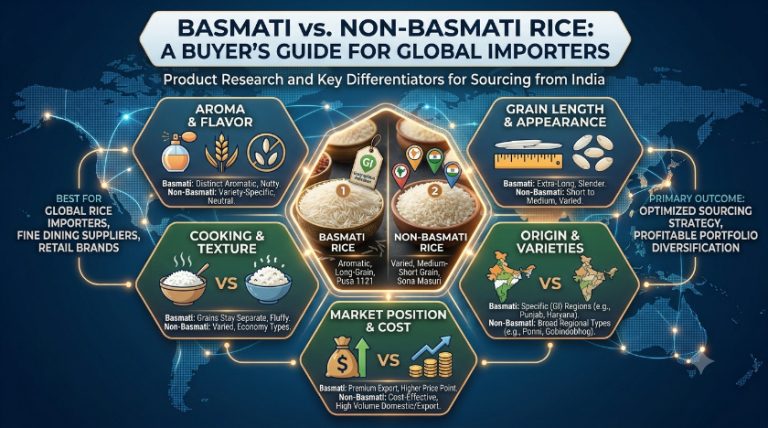
Practical Buyer Tip: If product terminology differs between your market and the Indian supplier’s market, use photographs and technical specifications for initial clarification, then approve a representative physical sample before shipment. For an example of how terminology shifts in other grains, review our guide on basmati vs non basmati rice.
Step 3: Build a Clear Product Specification
A written product specification is one of the most important documents in the sourcing process. Depending on the pulse, buyers may need to define exact size counts, moisture boundaries, foreign matter restrictions, insect-damaged limits, and crop years.
The specification should accurately reflect the pulse being purchased, the intended application, contractual quality expectations, and destination-market laws.
Expert Insight
A specification should be entirely measurable. Terms such as “premium quality,” “A grade,” and “export quality” are too subjective unless they are supported by defined parameters.
Step 4: Identify the Right Type of Supplier
Not every pulse supplier performs the same role. A buyer may encounter processors, millers, merchant exporters, or private-label specialists. The right supplier type depends on the order. For example, a buyer seeking custom retail packaging may need different processing capabilities from a bulk commodity importer purchasing large-volume sacks.
A capable trading or export company can add value through consolidation, documentation, and multi-product procurement. The key is transparency regarding who processes and controls the inventory. For broader context on matching with vendors, review how to find a reliable agro products supplier in India.
Step 5: Evaluate Supplier Identity and Capability
Before discussing a large order, verify that the supplier is a genuine and commercially capable business. A practical review includes verifying legal business names, tax registrations, facility processing limits, and export history parameters.
Red Flag
Be cautious when a supplier avoids basic verification questions, frequently changes banking beneficiary details, refuses to clarify the processing location, or makes broad claims without supporting information.
Step 6: Request Representative Samples
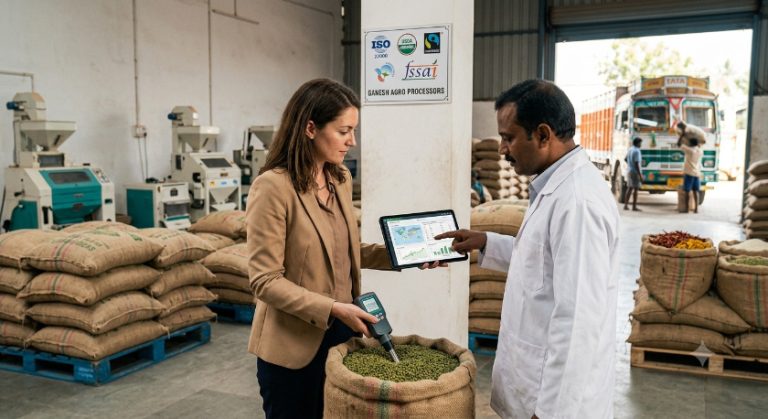
Samples are essential, but the sampling process must be controlled. A buyer should clarify whether the sample comes from current stock, whether it represents the bulk grade, and if the same specification can be maintained realistically at scale.
Sample Approval Rule: Never assume that approving a small sample automatically guarantees bulk-shipment consistency. The purchase contract should still define measurable quality parameters and inspection procedures.
Step 7: Test for the Intended Application
Visual inspection alone may not be enough. The correct testing approach depends on how the product will be used. Retail buyers look closely at visual uniformity and pack presentation. Foodservice buyers prioritise cooking yields and soaking behavior, while food processors require precise hydration data and recovery metrics.
Step 8: Compare Quotations on Equal Terms
A quotation is useful only when the commercial basis is clear. Before comparing suppliers, align the exact product grade, processing format, preferred Incoterm, port of entry, and inspection requirements.
Commercial Warning
Never compare pulse quotations using only the price per metric tonne. Standardise product specifications and trade conditions first.
Step 9: Understand Packaging Options
Packaging requirements vary by sales channel. Common commercial formats include woven polypropylene bags, laminated bags, bulk sacks, and smaller retail packs. Importers should explicitly confirm bag materials, net weights, inner liners, stitching methods, and country-of-origin marking rules to ensure durability during international handling.
Step 10: Review Food Safety and Destination Requirements
Import requirements vary by destination country. Depending on the market, buyers must review laws relating to pesticide residues, contaminants, phytosanitary certificates, and fumigation standards. The importer should independently verify current destination-country rules with relevant authorities.
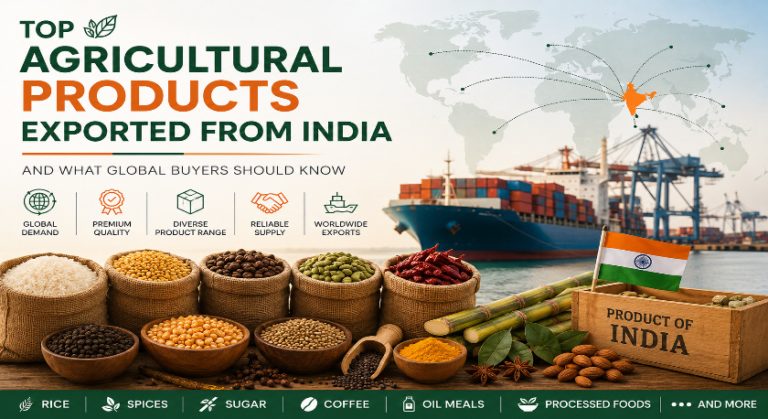
Compliance Note: Export eligibility from the origin country and import acceptance in the destination country are separate questions. Both should be reviewed before shipment. For details on historical trade profiles, cross-reference the top agricultural products exported from India.
Step 11: Plan Inspection Before Shipment
For commercial orders, especially new supplier relationships, buyers should implement a formal inspection plan covering quantity verification, visual quality reviews, laboratory specification testing, and loading supervision.
Buyer Protection Tip
Inspection is most useful when acceptance criteria are defined in advance. “Check quality before shipment” is too vague for a commercial control process.
Step 12: Review Logistics and Shipment Planning
Pulse sourcing does not end when the product leaves the facility. International buyers must consider container planning, moisture exposure risks, transit paths, and seasonal port factors. Both parties must clarify exact liabilities under the designated Incoterm.
Step 13: Confirm Documentation Requirements
Commercial shipments involve critical items such as commercial invoices, packing lists, bills of lading, certificates of origin, and phytosanitary papers. Correcting documentation after cargo movement can be difficult and expensive.
Step 14: Start with a Controlled First Order
A new supplier relationship should be scaled carefully. A controlled first transaction helps buyers evaluate communication response times, production consistency, and documentation accuracy before shifting to large-volume contracts.
Pulse Supplier Evaluation Checklist
Before approving an Indian supplier, confirm these 10 distinct operational areas:
Common Mistakes When Sourcing Pulses from India
- Requesting “Best Price” Without a Specification: Suppliers cannot provide truly comparable quotations without a defined product requirement.
- Assuming Trade Names Are Universal: The exact same pulse may be described differently across different regional import markets.
- Approving Only by Photograph: Images cannot reliably confirm moisture balances, purity levels, or actual cooking behaviors.
- Ignoring Processing Details: Whole, split, polished, unpolished, skin-on, and dehusked products serve completely different consumer segments.
- Skipping Destination Compliance Checks: Commercially viable products may still face abrupt import rejections if pesticide residue levels exceed limits.
- Changing Specifications After Price Agreement: Late structural changes always impact availability timelines and core logistics costs.
How IIMCL Supports Pulse Sourcing from India
International buyers often need more than a simple list of supplier names. A structured sourcing process involves defining precise criteria, identifying compliant processing units, establishing documentation frameworks, and verifying sample parameters.
At IIMCL, we work with international businesses exploring sourcing opportunities across Indian agro products and other business categories. You can browse our general catalog on our product or shop page, access our dedicated Agro Products page, or connect with us directly via our Contact Us page to begin a structured procurement conversation.
To help us focus your enquiry, please share your required pulse variety, split/whole preferences, target volume, and destination port details during your initial outreach.
Frequently Asked Questions
What parameters should be included in a pulse sourcing specification sheet?
A comprehensive specification sheet should clearly define the exact variety, split or whole format, size or count, moisture percentage limits, maximum foreign matter, damaged or discoloured grain allowances, and the specific crop year.
Can I import any type of pulse from India without restrictions?
No. Pulse export regulations can fluctuate based on domestic market demand, crop cycles, and changing government policies. It is essential to check current trade conditions for your specific pulse type before entering into contracts.
Why is it a mistake to compare pulse suppliers based on price per tonne alone?
A lower price quote often indicates a compromise in quality variables, such as a higher percentage of broken pulses, elevated moisture levels, basic or less durable packaging materials, or less favorable Incoterms that omit critical shipping costs.
How can buyers ensure sample consistency matches the bulk shipment?
Buyers should incorporate strict pre-shipment inspections by independent third-party agencies. The purchase contract must explicitly state that bulk shipments must conform to the measurable parameters verified in the approved reference sample.
Discuss Your Pulse Sourcing Requirement
A secure international trade setup begins with clear product parameters and objective vendor verification. Let our team help streamline your agricultural procurement requirements from India.