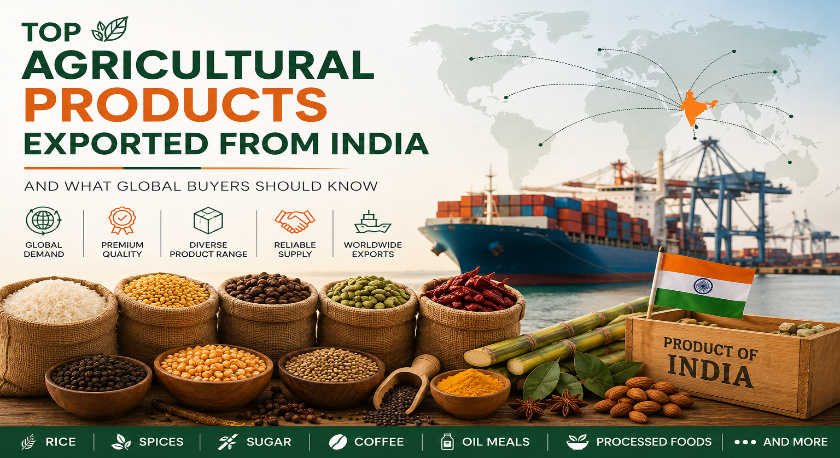
Top Agricultural Products Exported from India and What Global Buyers Should Know
Top Agricultural Products Exported from India and What Global Buyers Should Know
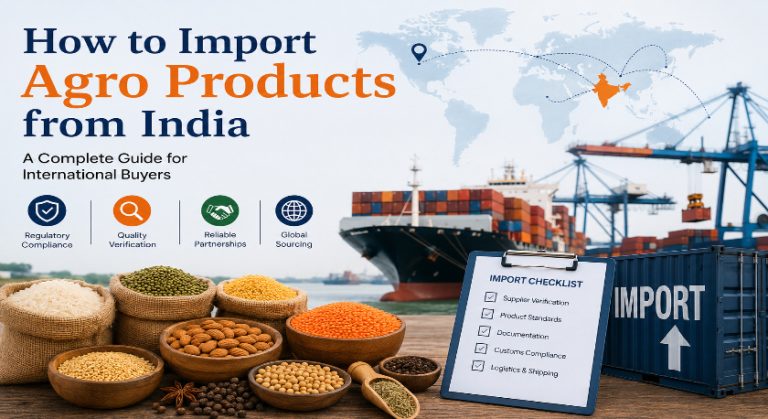
India has long been an important participant in global agricultural trade, supplying a broad range of food products and agricultural commodities to international markets. From rice and spices to sugar, coffee, oil meals, processed foods, and other product categories, the country offers global buyers access to a diverse sourcing base.
For importers, distributors, procurement teams, and businesses exploring agricultural products exported from India, the opportunity is significant. However, successful sourcing involves more than identifying a product and requesting a price. Buyers also need to consider specifications, quality expectations, packaging, documentation, destination-market requirements, commercial terms, and supply coordination.
This guide examines some of the leading agricultural products exported from India and explains the practical factors global buyers should evaluate before moving forward with a sourcing decision.
For businesses currently exploring Indian agricultural products, IIMCL’s Agro Products division provides an overview of relevant sourcing categories and business solutions.
Core Sourcing Takeaways
Successful agricultural procurement from India relies on unambiguous technical specifications, rigorous validation against target destination compliance benchmarks, and proactive alignment with real-time regulatory policies rather than historical pricing metrics.
Why India Matters in Global Agricultural Trade
India’s agricultural economy is exceptionally diverse. Different regions support the production of cereals, pulses, spices, oilseeds, fruits, vegetables, plantation crops, and a wide range of processed food products.
This diversity gives international buyers access to multiple sourcing categories within one country. More importantly, India’s export ecosystem includes producers, processors, packers, traders, logistics providers, inspection systems, and businesses experienced in serving overseas markets.
Official APEDA export information shows the breadth of India’s agricultural trade. In its 2024-25 overview, major exported commodities included non-Basmati rice, Basmati rice, spices, sugar, coffee, oil meals, processed items, and other categories. The exact export position of individual products can change from year to year due to production, international demand, prices, policy decisions, and market conditions.
For global buyers, this means India should not be viewed as a source for only one or two commodities. It is a broad agricultural sourcing market with opportunities across staple foods, specialty products, ingredients, and processed categories. Access the official APEDA Agri Export Overview for extensive sector analytics.
Top Agricultural Products Exported from India
The following categories are among the most relevant when discussing India’s agricultural export landscape. The right sourcing opportunity depends on the buyer’s market, required specification, quantity, quality expectations, and applicable import rules.
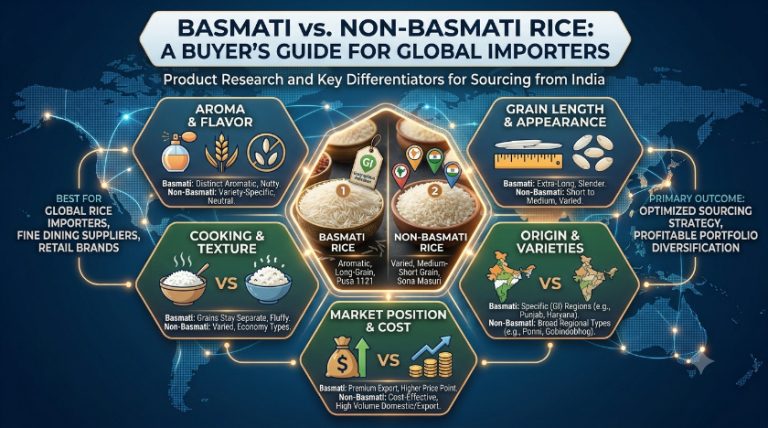
1 Basmati Rice
Basmati rice is one of India’s most internationally recognized agricultural products. It is valued for characteristics such as long grains, aroma, cooking quality, and its established use across household, retail, hospitality, and food-service markets.
According to APEDA, India exported more than 6 million metric tonnes of Basmati rice in 2024-25, with an export value of approximately US$5.94 billion. Major destinations listed by APEDA included Saudi Arabia, Iraq, Iran, the United Arab Emirates, and Yemen. These figures illustrate the scale of international demand for Indian Basmati rice.
For buyers, however, the term “Basmati rice” alone is not a complete specification. A sourcing enquiry may need to clarify matters such as: required variety, grain characteristics, raw, steamed, or parboiled preference, packaging format, quantity, destination country, quality parameters, and private-label requirements, where applicable. A precise enquiry helps reduce confusion and makes supplier discussions more productive.
2 Non-Basmati Rice
Non-Basmati rice is another major component of India’s agricultural export trade. It serves a wide range of international markets and buyer requirements.
APEDA’s 2024-25 agricultural export overview valued non-Basmati rice exports at approximately US$6.53 billion, making it one of the leading categories in the country’s agricultural export basket. Global buyers may source non-Basmati rice for wholesale distribution, retail markets, institutional supply, food-service channels, processing applications, or market-specific consumption needs.
The exact variety and specification matter. Buyers should avoid sending enquiries that simply ask for “rice price.” Instead, they should provide as much information as possible about the required product, quantity, destination, packaging, and expected quality parameters. Interested businesses can also browse IIMCL’s export product range to understand relevant sourcing categories.
3 Spices
India has a deep historical connection with the global spice trade. Indian spices are used across household cooking, food manufacturing, hospitality, seasoning production, and ingredient supply chains.
Depending on the market and supplier capabilities, internationally traded spice categories may include products such as turmeric, chilli, cumin, coriander, pepper, cardamom, and other whole or processed spices. APEDA’s agricultural export overview placed spices among India’s leading export commodities in 2024-25, with an indicated value of approximately US$4.45 billion.
For global buyers, sourcing spices requires careful attention to the exact product form and specification. A whole spice, ground spice, blended product, or processed ingredient can involve different requirements. Important considerations may include grade, moisture parameters, purity expectations, processing method, packaging, testing requirements, destination-country regulations, and labelling requirements. Therefore, buyers should establish the intended use of the product before finalizing a sourcing approach.
4 Sugar
Sugar is another significant agricultural commodity associated with Indian trade. Depending on market conditions and applicable policies, India can play an important role in international sugar supply. APEDA’s 2024-25 overview listed sugar exports at approximately US$2.16 billion.
However, sugar is a category where buyers need to pay close attention to current trade conditions. Agricultural commodities can be affected by domestic supply considerations, government policy, international prices, and export rules. Before progressing with a transaction, buyers should clarify the required sugar type, grade or specification, intended application, quantity, packaging, destination port, shipment expectations, and current export availability. A responsible sourcing process should verify current conditions rather than relying on outdated assumptions.
5 Coffee
India’s coffee sector serves international markets with products from several producing regions. Indian coffee can be relevant to roasters, distributors, food businesses, ingredient buyers, and other commercial purchasers. APEDA’s 2024-25 overview placed coffee exports at approximately US$1.81 billion.
For buyers, coffee sourcing decisions may depend on variety, origin, processing method, grade, bean characteristics, volume, packaging, and intended end use. A procurement team sourcing green coffee beans will naturally have different requirements from a buyer seeking a processed or retail-ready product. Therefore, the initial enquiry should clearly explain the commercial need.
6 Oil Meals
Oil meals are an important part of agricultural and feed-related trade. These products generally emerge from oilseed processing and can be relevant to feed and industrial supply chains, depending on the specific commodity and destination market. APEDA’s 2024-25 overview included oil meals among the country’s top agricultural export commodities, with an indicated value of approximately US$1.34 billion.
Buyers should pay close attention to source material, product specification, intended use, composition requirements, quality parameters, destination regulations, and shipment size. As with other bulk agricultural commodities, a detailed specification is essential.
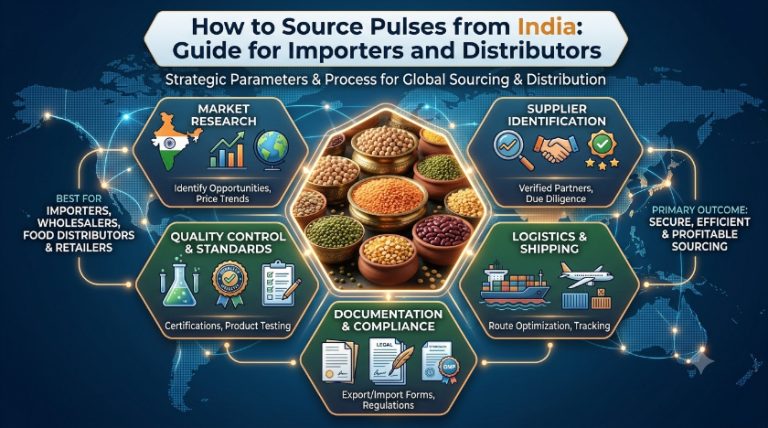
7 Pulses and Related Food Staples
Pulses are central to food consumption across many regions and remain an important category in agricultural trade. Depending on supply conditions, product availability, and market requirements, Indian businesses may work with categories such as lentils, dals, and other staple products.
For buyers, terminology is especially important. The same broad commodity may be traded in different forms, including whole, split, polished, unpolished, processed, or market-specific grades. Therefore, an enquiry for “dal” or “pulses” should be supported by the exact product name and required specification. Global buyers exploring such categories can review IIMCL’s broader agricultural product sourcing capabilities.
8 Processed Food Products
India’s agricultural export story extends beyond raw commodities. Processed foods form a substantial part of the broader export ecosystem. APEDA reports that processed food exports reached approximately US$7.89 billion in 2024-25 across the categories it tracks.
Depending on the product and market, processed food opportunities may include processed fruits and vegetables, cereal preparations, food ingredients, packaged products, value-added agricultural products, and other processed categories. For international buyers, processed foods often require additional attention to ingredient declarations, shelf life, packaging integrity, labelling, destination-market compliance, storage conditions, and product registration requirements where applicable. This makes supplier evaluation particularly important.
What Global Buyers Should Know Before Sourcing from India
Knowing the top agricultural products exported from India is useful, but product popularity alone should not determine a procurement decision. A successful B2B sourcing process requires a more disciplined approach.
Define the Product Specification Clearly
One of the most common weaknesses in an initial sourcing enquiry is insufficient detail. For example, the request “We need rice. Send best price.” is too broad. A stronger enquiry would systematically identify the exact rice category or variety, required quantity, packaging format, destination country, destination port, preferred shipment schedule, and relevant quality parameters.
Confirm Destination-Market Requirements
Import rules vary by country and product. A product suitable for one destination may require completely different documentation, labelling, testing, certificates, packaging, treatment, registration, or inspection for another destination. Buyers must identify the applicable requirements in their own market before finalizing a transaction, especially regarding sanitary, phytosanitary, and food-safety standards.
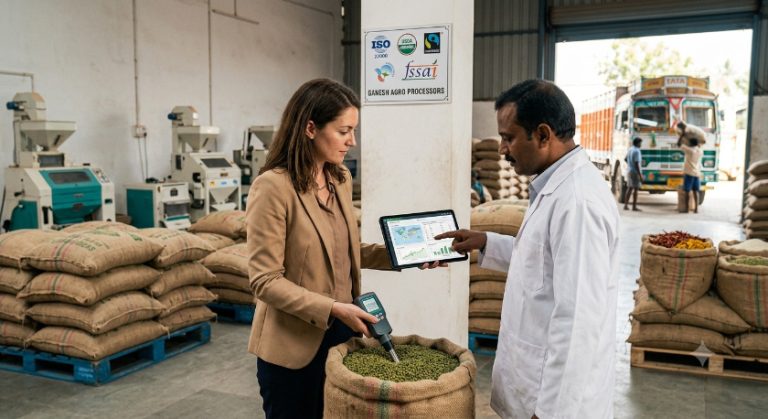
Evaluate Quality and Consistency
A competitive price is important, but it should not be the only consideration. Commercial buyers should evaluate structural consistency between shipments, agreed specifications, packaging durability, documentation clarity, handling expectations, and complete product traceability where required.
Discuss Packaging Early
Packaging affects product protection, handling, logistics, storage, branding, and compliance. A bulk commodity buyer may require industrial packaging, while a distributor requires retail-ready configurations. Private-label buyers must clarify artwork, language, and regulatory label requirements early in the process.
Clarify Quantity and Commercial Terms
Suppliers need realistic quantity metrics to assess viability. Avoid ambiguous terms like “Need large quantity.” Provide actionable ranges such as trial order volumes, expected monthly capacity, specific container counts, or annual estimates. Commercial parameters must cleanly define payment configurations and delivery Incoterms.
Dynamic Market Consideration
Agricultural trade is inherently influenced by crop conditions, domestic demands, international price spikes, logistical bottlenecks, and changing government export policies. Sourcing teams must base planning on real-time trade data rather than outdated historical quotations.
How to Evaluate an Agro Products Supplier in India
Choosing a supplier should involve more than comparing quotations. Global buyers should consider several practical questions:
A supplier should be able to discuss technical product requirements comprehensively rather than responding only with a generic price list.
Packaging options directly affect shelf stability, logistics overheads, and target market suitability.
Cross-border deals involve multiple moving parts. Tardy or inconsistent communication introduces structural risk to supply schedules.
All technical specifications, quality limits, shipment schedules, and penalties must be recorded within binding contracts.
Why Buyers Should Look Beyond the Lowest Price
Price is naturally important in agricultural sourcing. However, the lowest quotation does not automatically represent the best commercial outcome. A lower price may become less attractive if the transaction later faces problems involving inconsistent quality, incorrect specifications, unsuitable packaging, delivery delays, documentation issues, or unexpected logistics complications.
Professional buyers evaluate the total sourcing proposition rather than the unit price alone. That means considering product suitability, reliability, communication depth, packaging integrity, commercial clarity, and supply continuity. A sustainable sourcing relationship should create real value beyond a single quotation.
How IIMCL Supports Agricultural Product Enquiries
India International Marketing Centre Limited has business experience dating back to 1993 and works across multiple business divisions, including Agro Products. For international buyers exploring Indian agricultural products, the first step is to share a clear and detailed requirement.
Relevant information may include product name, exact specification, quantity thresholds, packaging type, destination country, destination port, expected timeline, and any relevant quality or compliance requirements. Based on the information provided, the relevant business team can review the enquiry and determine the appropriate next steps.
Buyers can explore IIMCL’s Agro Products division for more information about the company’s agricultural business categories, or view available export product categories through our product shop section.
Frequently Asked Questions
What are the top agricultural products exported from India?
India exports a broad range of agricultural commodities and food products. Major categories include rice, spices, sugar, coffee, oil meals, processed foods, and other products. The ranking and value of individual categories can change by year depending on demand, production, prices, and trade conditions.
Is India a major exporter of rice?
Yes. Rice is one of India’s most important agricultural export categories. Both Basmati and non-Basmati rice have substantial international markets. APEDA’s 2024-25 data shows significant export values for both categories.
What should international buyers provide when requesting a quotation?
Buyers should ideally provide the exact product, specification, quantity, packaging requirement, destination country, destination port, expected timeline, and any relevant quality or compliance requirements.
Can global buyers source multiple agricultural products from India?
Potentially, yes. India has a broad agricultural production and processing base. However, availability, supplier capability, commercial feasibility, and export conditions should be assessed separately for each product.
How can I find a reliable agro products supplier in India?
Evaluate suppliers based on product understanding, communication, specification clarity, packaging capability, documentation, commercial terms, and ability to address destination-market requirements. Avoid choosing a supplier solely because it offers the lowest initial price.
Do agricultural export requirements vary by destination country?
Yes. Import rules, food-safety requirements, labelling, documentation, testing, and other conditions can vary by product and destination. Buyers should verify the applicable requirements for their market.
How can I contact IIMCL about an agricultural sourcing requirement?
You can submit a detailed business enquiry with your required product, quantity, packaging, destination, and timeline. The relevant IIMCL team can then review the information provided. Feel free to contact IIMCL about your sourcing requirement directly through our communication portal.
Looking to Source Agricultural Products from India?
Whether you are an importer, distributor, procurement team, or international business exploring agricultural products from India, a clear sourcing process begins with a detailed requirement. Share your product parameters with our team to initiate a structural review.