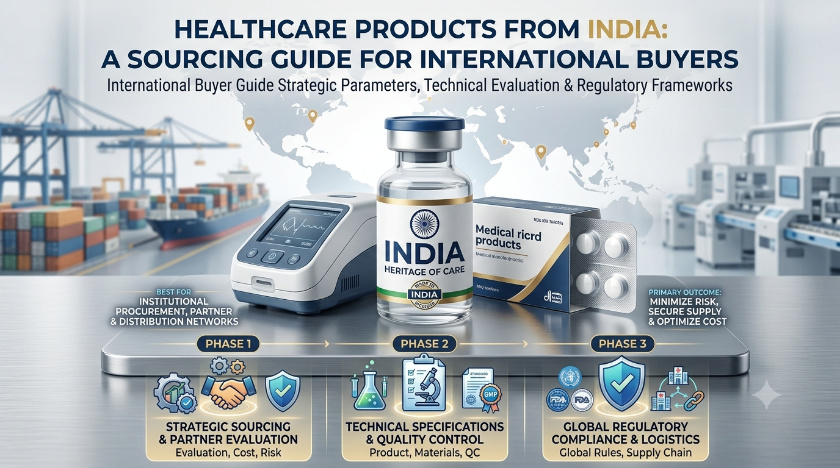
Healthcare Products from India: A Sourcing Guide for International Buyers
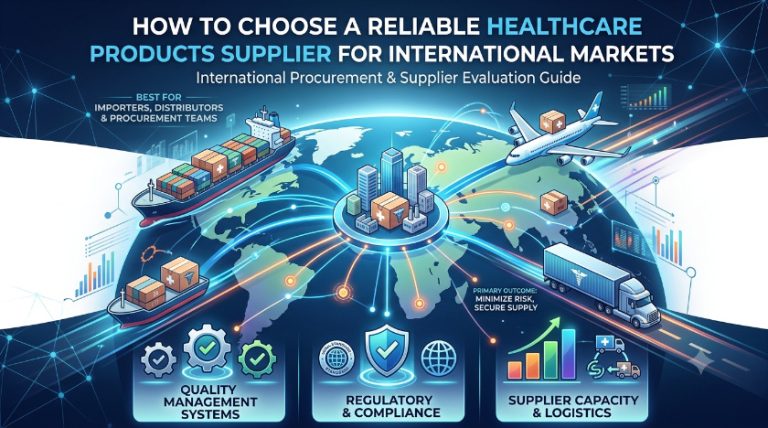
Healthcare Products from India: A Sourcing Guide for International Buyers
Specifically, this guide details strategic parameters, technical evaluation metrics, and regulatory frameworks for international distribution networks, institutional procurement groups, and commercial health enterprises.
To begin with, India has developed a substantial position in global healthcare supply, effectively demonstrating capabilities spanning pharmaceuticals, medical devices, diagnostics, healthcare consumables, hospital-use products, and other health-related categories. Consequently, for international importers, distributors, procurement teams, and institutional buyers, this dynamic creates highly significant sourcing opportunities.
However, sourcing healthcare products from India strictly requires a different level of care compared to purchasing ordinary commercial goods. For instance, a particular product may be subject to strict regulatory controls. Furthermore, required documentation may vary drastically by destination country. Similarly, a medical device may need classification-specific safety review. Moreover, a pharmaceutical product will invariably involve destination market authorization requirements. Ultimately, even comparatively straightforward healthcare consumables can require precise specifications, material information, packaging standards, shelf-life considerations, or buyer-specific quality expectations.
The Scale of Export Operations
India’s pharmaceutical export scale consistently provides a very useful context. Indeed, a Government of India release reported pharmaceutical exports reaching roughly US$30.47 billion in FY2024-25, clearly representing 9.4% growth over the previous year. For international buyers, though, overall market size alone is simply not enough. Ultimately, the real commercial task is to identify the absolutely correct product, comprehensively evaluate the supplier, thoroughly understand all applicable requirements, and thoughtfully structure the procurement process.
Therefore, this guide systematically explains the practical issues international buyers should actively consider when sourcing healthcare products from India. Additionally, businesses exploring highly relevant sourcing categories can easily review IIMCL’s Healthcare Solutions division.
Key Takeaway: Importantly, in healthcare sourcing, supplier price must always come completely after product definition, regulatory classification, technical requirements, and quality verification. Because a commercially attractive offer essentially has zero value if the product cannot legally or safely cross into your target market.
Why International Buyers Source Healthcare Products from India
Undoubtedly, India’s modern healthcare and pharmaceutical ecosystem purposefully includes a wide range of manufacturers, exporters, research organizations, service providers, distributors, and specialized supply businesses.
Furthermore, the country’s broad export capabilities successfully extend across multiple pharmaceutical categories. Specifically, Pharmexcil directly describes its scope as including vital areas such as active pharmaceutical ingredients, finished dosage forms, pharmaceutical-grade excipients, biologics, nutraceuticals, contract manufacturing, clinical research, and regulatory services. Consequently, for international buyers, India can therefore represent significantly more than a single-product sourcing market.
Accordingly, depending on the exact requirement and supplier capability, buyers may actively explore categories connected to:
- Pharmaceutical products
- Active pharmaceutical ingredients
- Medical devices
- Diagnostic products
- Hospital-use products
- Medical consumables
- Healthcare accessories
- Wellness-related categories
- Selected institutional healthcare requirements
However, the general phrase “healthcare products” remains extremely broad. Thus, buyers should never mistakenly assume that one supplier is equally capable across every single category. For example, a company highly experienced in hospital consumables may definitively not be the right source for heavily regulated medical devices. Likewise, complex pharmaceutical sourcing involves completely different operational considerations from purchasing basic non-drug healthcare accessories. Therefore, the first universal rule is simple: Always define the specific product before formally evaluating the supplier.
Understanding the Main Healthcare Product Categories
First and foremost, before contacting potential suppliers, international buyers must definitively determine which specific category their requirement belongs to. Indeed, this classification matters immensely because different categories will invariably involve different specifications, required documentation, legal regulations, quality systems, storage conditions, labelling requirements, and customs import procedures.
Pharmaceuticals
API components, generic formulations, dosage units, over-the-counter options.
Medical Devices
Equipment, diagnostic hardware, instruments categorized by risk matrices.
Medical Consumables
Procedural goods, single-use elements, sterile/non-sterile barrier supplies.
Diagnostics
Laboratory items, in-vitro testing systems, specific chemical reagents.
Hospital Products
Institutional hardware, spatial support units, and specialized clinical assets.
Wellness Products
Nutraceutical complexes, preventive formulations, specific skin application series.
1. Pharmaceutical Products
Primarily, India has a massive pharmaceutical export sector consistently serving international markets. Accordingly, depending on the specific business, product, and destination market, commercial sourcing discussions may frequently involve complex categories such as finished dosage forms, generic medicines, active pharmaceutical ingredients, selected over-the-counter categories, and other allied pharmaceutical products.
However, pharmaceutical sourcing strictly requires extremely careful regulatory review. For example, a product that is commercially available in India is certainly not automatically authorized for legal sale in another country. As a result, the importer must meticulously consider destination-specific matters such as product registration, marketing authorization, approved manufacturer status, labelling, pharmacopoeial requirements, certificates, testing, import licences, and localized regulatory procedures. Therefore, international buyers should unconditionally confirm all applicable requirements before finalizing any transaction.
2. Medical Devices
Similarly, medical devices represent another incredibly important healthcare sourcing category. However, the term itself can cover a vastly broad range of products. Depending on the applicable regulatory framework, products may consistently differ significantly regarding intended use, clinical risk, classification, technical requirements, documentation, and manufacturing controls.
Moreover, India’s Central Drugs Standard Control Organisation (CDSCO) maintains highly dedicated medical-device and diagnostics resources, while the Medical Devices Rules, 2017 form a crucial part of India’s regulatory framework for medical devices. Ultimately, for international buyers, this firmly means “medical device” should never be recklessly treated as one simple procurement category. Consequently, the sourcing process should always begin with: exact device name, intended use, model, specification, applicable classification, required quantity, destination country, and destination regulatory requirements.
3. Medical Consumables
Additionally, medical consumables can be highly relevant to hospitals, clinics, distributors, laboratories, institutional buyers, and other healthcare supply channels. Consequently, sourcing discussions may frequently involve single-use products, examination-related consumables, procedural consumables, patient-care products, protective products, and selected disposable healthcare items.
Therefore, the exact product details matter immensely. A professional buyer should purposefully avoid unhelpfully broad requests such as: “Need medical disposables.” Instead, carefully specify the exact product, base material, precise dimensions, size, sterile or non-sterile requirement, packaging, quantity, intended use, applicable standards, and destination market to make supplier evaluation significantly more meaningful.
4. Diagnostic and Laboratory-Related Products
Furthermore, healthcare sourcing may also regularly involve diagnostic and laboratory-related categories. Indeed, these sensitive products can differ significantly regarding technical complexity and regulatory status. Depending on the exact testing item, buyers will invariably need to tightly consider intended use, technical specification, hardware compatibility, strict storage conditions, shelf life, temperature requirements, documentation, and destination-country authorization.
Importantly, CDSCO maintains entirely dedicated resources specifically for in-vitro diagnostics and medical-device regulation. Thus, for international buyers, the essential key lesson is that diagnostic products must be meticulously evaluated according to their exact regulatory and technical context, rather than simply treated as general merchandise.
5. Hospital and Institutional Healthcare Products
Meanwhile, major hospitals and institutional buyers may also require a remarkably broad range of operational products beyond just pharmaceuticals and regulated devices. For instance, requirements may often involve patient-care items, selected hospital-use products, healthcare accessories, institutional consumables, examination-related products, and vital support products.
Consequently, large institutional procurement can frequently involve massive additional complexity because buyers may rigidly require tender specifications, exact dimensions, approved materials, technical documents, physical samples, distinct packaging configurations, and recurring supply schedules. Therefore, the supplier must be strictly evaluated against the actual, granular procurement requirement.
6. Wellness and Preventive-Care Categories
Finally, the broader healthcare market can comprehensively include selected wellness and preventive-care products. However, buyers should be extremely careful with legal classification. Specifically, a product actively marketed as wellness, nutraceutical, cosmetic, medical, or therapeutic may be legally treated entirely differently under various destination regulatory systems. Ultimately, marketing language absolutely does not determine legal classification. Thus, international buyers must rigorously verify exactly how the product is classified within the destination market before making assumptions about registration, labelling claims, or customs import procedures.
Start with a Precise Healthcare Product Specification
Undoubtedly, a highly effective healthcare sourcing process logically begins long before the first supplier quotation arrives. Therefore, the buyer should meticulously prepare a perfectly clear requirement. For example, the common enquiry “We need hospital products. Send catalogue and best price” is functionally far too broad. Instead, a vastly stronger enquiry fundamentally includes:
| Technical Requirement Dimension | Sourcing Assessment Variable |
|---|---|
| Core Identification | Exact product name, technical model, reference code, intended medical use |
| Material Properties | Exact raw material types, dimensions, scale sizing, specific configurations |
| Sterilization State | Sterile or non-sterile necessity, exact packaging methods, validation type |
| Compliance Criteria | Destination market registration tier, certificate types, language, label layout |
| Commercial Conditions | Order volumes, shelf-life boundaries, logistics Incoterm parameters |
Consequently, the more heavily regulated or technically complex the intended product, the more critically important this baseline preparation becomes. Ultimately, a highly precise requirement effectively helps the buyer easily distinguish between capable suppliers who genuinely understand the product and those simply responding with automated, generic sales material.
Verify the Supplier’s Business Identity
Crucially, before discussing any major order, you must firmly establish exactly who you are dealing with. Specifically, thoroughly review core information such as the legal company name, registered address, official website, business email domain, relevant company details, quotation identity, invoice identity, and payment beneficiary information at the appropriate stage. Consequently, all these vitally important details should be reasonably consistent across platforms.
Furthermore, potential issues completely deserve urgent clarification whenever quotation and invoice names suspiciously differ without logical explanation, payment is strangely requested to a totally unrelated entity, contact information repeatedly changes, company addresses are confusingly inconsistent, or the supplier purposefully avoids answering basic verification questions. Admittedly, a single inconsistency does not automatically prove deliberate wrongdoing. However, utterly unexplained inconsistencies should absolutely never be ignored by a professional buyer.
Evaluate Product-Specific Regulatory Readiness
Indisputably, this is one of the absolute most critical parts of global healthcare sourcing. Therefore, do not simply ask: “Is your company certified?” Because that question is functionally far too broad. Instead, aggressively deploy a highly disciplined, multi-step assessment pathway:
First, thoroughly clarify exact product clinical claims, core materials, specific models, and precise application fields.
Next, strictly determine exact device or drug tiering according to the strict destination authority criteria.
Thereafter, actively check valid manufacturing licences, certified ISO frameworks, and explicit site address alignment.
Furthermore, deeply review certificate validity, laboratory data verification, and Free Sale Certificates if commercially applicable.
Finally, ensure complete confirmation of importer liability rules and direct local clearance procedures.
For example, regarding medical devices, India’s regulatory framework firmly includes the Medical Devices Rules, 2017, and the CDSCO continually provides dedicated medical-device resources. In addition, the CDSCO also publishes highly useful guidance concerning Free Sale Certificates for certain export contexts involving officially licensed Indian medical-device manufacturers. Ultimately, always ask for highly product-specific evidence, rather than accepting unverified, generic claims.
Understand That Destination-Country Rules Come First
Unfortunately, a massively common sourcing mistake is falsely assuming that because a product can be safely manufactured or sold in India, it can automatically be legally imported and marketed elsewhere. Indeed, that assumption is absolutely not necessarily true. Often, the destination market may maintain completely separate requirements involving importer registration, product authorization, local representation, device/pharmaceutical registration, strict labelling, specific language, technical documentation, conformity assessment, lab testing, and mandatory post-market obligations.
Consequently, the buyer should rigorously verify these exact requirements directly with the relevant governmental authority located in the destination country. For instance, specific requirements in the European Union, the United States, the United Kingdom, Gulf markets, African markets, and Southeast Asian markets may easily differ substantially. Therefore, never lazily rely on a simple supplier statement such as: “This product is export quality.” Unquestionably, “export quality” is fundamentally not a legally recognized universal regulatory approval.
Review Quality Systems and Manufacturing Information
Subsequently, depending entirely on the specific product, buyers may critically need to evaluate the core manufacturer’s internal quality systems. Consequently, highly relevant questions can include: Firstly, who actually manufactures the final product? Secondly, is the seller genuinely the manufacturer, an exporter, a distributor, or merely a sourcing intermediary? Additionally, exactly where is the product physically manufactured? Furthermore, what specific quality system accurately applies? Also, what distinct product-specific documentation is readily available? Moreover, how exactly are production batches or lots rigidly controlled? Lastly, how are customer complaints effectively handled, and how are critical specification changes managed?
Ultimately, the professionally appropriate level of review firmly depends on the exact product risk. For example, a low-risk healthcare accessory and a heavily regulated medical device should absolutely not undergo the exact same evaluation process. Therefore, for higher-risk or heavily regulated products, buyers may essentially need to engage specialist regulatory and quality expertise.
Distinguish the Manufacturer from the Exporter or Trader
Typically, the company sending the commercial quotation may actually be the manufacturer, an authorized distributor, a dedicated exporter, a broad trading company, or a sourcing intermediary. Importantly, none of these specific structures is automatically inherently good or bad. Rather, what truly matters is operational transparency. Therefore, boldly ask who physically manufactures the product, whose exact name appears on the legal label, who specifically holds relevant operating licences, who technically issues product documents, who is legally responsible for quality complaints, who serves as the contractual seller, and who precisely receives the financial payment. Indeed, a highly capable exporter can easily add massive value through seamless coordination, broad product access, consolidated logistics, and rapid communication. However, the exact commercial structure should always be understood completely clearly.
Request and Review Product Documentation
Invariably, global healthcare procurement frequently requires substantially more documentation than ordinary commercial sourcing. Accordingly, depending heavily on the product and destination, buyers may constantly discuss documents such as formal product specifications, verified technical data, official certificates of analysis (where strictly applicable), manufacturing site information, certified quality certificates, accredited test reports, sterilization validation information (where relevant), empirical shelf-life data, product registration confirmation, Free Sale Certificates (where applicable), approved labelling artwork, precise instructions for use, and final packaging details.
Naturally, not every single document seamlessly applies to every product type. However, the ultimate goal is not merely to indiscriminately collect the largest possible PDF folder. Instead, the real goal is to precisely identify which key documents are truly relevant and independently verify that they directly correspond to the exact actual product currently being offered.
Check Product Classification Carefully
Furthermore, international healthcare classification can become notoriously complex. For instance, a buyer may broadly describe an item as a “medical product,” while the destination legal authority may strictly classify it entirely differently into specific categories like a licensed drug, medical device, in-vitro diagnostic, cosmetic, nutraceutical, general wellness product, or non-medical consumer product. Consequently, this legal classification heavily affects the entire procurement process by rigidly determining mandatory registration, required labelling, permitted claims, strict importer obligations, required documentation, and final market authorization. Therefore, whenever classification remains unclear, immediately obtain qualified regulatory advice before recklessly placing a major order.
Evaluate Samples Before a Larger Commitment
Whenever commercially and legally appropriate, physical samples can certainly help careful buyers visually assess physical appearance, exact dimensions, material quality, packaging strength, labelling clarity, basic mechanical functionality, and general alignment with written specifications. However, sample approval fundamentally has inherent limits. Crucially, a single beautiful sample absolutely does not automatically prove future batch consistency, broad regulatory compliance, massive manufacturing capacity, rapid shipment reliability, or long-term systemic quality performance. Therefore, for highly relevant products, sample evaluation may absolutely need to be combined deeply with strict written specifications, independent testing, deep documentation review, factory inspection, and thorough regulatory verification entirely based on the clinical risk and complexity of the product.
Pay Close Attention to Packaging and Labelling
Importantly, healthcare packaging is certainly not merely aesthetic or decorative. Depending strictly on the product type, correct packaging may vitally support product protection, maintain sterility, enable traceability, survive storage, endure transport, communicate user information, and ensure regulatory compliance. Therefore, buyers should proactively clarify exact primary packaging, strong secondary packaging, units per box, cartons per shipment pallet, label language translation, batch lot information, manufacturing site information, expiry date information, explicit storage instructions, barcode scanning requirements, and specific private-label needs. Consequently, absolutely do not wait until production is nearly complete to carelessly discuss packaging; rather, it should be heavily addressed early.
Review Shelf Life and Expiry Requirements
Furthermore, many essential healthcare products maintain strictly defined shelf lives. Consequently, international buyers should ruthlessly clarify total intended shelf life, exact remaining shelf life at shipment time, estimated remaining shelf life upon arrival, original manufacturing date, final expiry date, required storage conditions, internal buyer policy, and specific institutional tender requirements. Indeed, this is especially critically important whenever transit times are agonizingly long, destination customs clearance can be notoriously slow, products desperately require extensive local distribution after arrival, or institutional buyers rigidly impose strict minimum remaining shelf-life requirements. Ultimately, a product with a theoretically acceptable total shelf life may unfortunately still be totally commercially unsuitable if vastly too little viability remains when it finally reaches the buyer.
Assess Storage and Temperature Requirements
Similarly, while some robust healthcare products can easily move safely through ordinary logistics channels, others may drastically require tightly controlled conditions involving cool ambient storage, strict temperature limits, controlled humidity, active cold-chain requirements, UV light protection, or highly special handling. Therefore, absolutely do not lazily assume standard conditions apply. Instead, aggressively ask for the rigidly applicable storage requirements in writing and actively ensure that the planned external logistics process is totally suitable. Unquestionably, highly temperature-sensitive products always require particularly careful and flawless coordination.
Compare Healthcare Supplier Quotations Properly
Ultimately, a dramatically lower quoted price absolutely does not necessarily mean a vastly better commercial offer. Therefore, before carelessly comparing financial quotations, methodically check whether each prospective supplier is genuinely offering the exact same identical product, correct model, exact material, identical dimensions, matched specification, verified sterile status, identical packaging, same quantity, safe shelf life, equivalent documentation scope, identical delivery term, matched destination, and similar shipment schedule. For example, Supplier A may aggressively quote a surprisingly lower unit price but quietly provide significantly inferior packaging. Meanwhile, Supplier B may responsibly include vital accredited testing or required documentation that Supplier A conveniently excludes. Alternatively, Supplier C may confusingly be quoting an entirely different logistical delivery basis. Ultimately, these are absolutely not directly comparable competitive offers. Consequently, create a highly structured spreadsheet comparison sheet before officially selecting a final supplier.
Understand Delivery Terms and Logistics Responsibilities
Moreover, global international healthcare sourcing can frequently involve wildly different logistical delivery arrangements. For instance, commercial export quotations may routinely refer to standard terms such as EXW, FOB, CFR, or CIF. Consequently, the buyer must fully understand the exact agreed Incoterm and precisely named place or port. Therefore, ruthlessly clarify exactly who actively arranges domestic inland transport, who physically handles export customs procedures, who legally books international ocean freight, who bears specified financial costs, whether comprehensive insurance is fully included where relevant, and who finally manages destination import clearance. Furthermore, healthcare products may also frequently involve highly special logistics requirements heavily depending on strict temperature, physical fragility, required sterility, hazardous material classification, high shipment value, or rigid regulatory controls. Thus, for highly complex or sensitive shipments, always use exceptionally qualified logistics and customs professionals.
Consider Inspection and Pre-Shipment Verification
Finally, depending strongly on product clinical risk and total transaction value, careful buyers may proactively consider implementing verification measures such as independent specification review, third-party document review, structural packaging inspection, exact quantity verification, formal pre-shipment inspection, accredited independent testing, or professional loading supervision. Naturally, not absolutely every transaction mandates every single measure. However, a highly sensible approach actively considers inherent product risk, destination regulatory complexity, total order value, known supplier history, internal buyer policy, and strict destination import requirements. Consequently, entirely new supplier relationships may easily justify significantly more rigorous verification than deeply established ones.
Common Red Flags in Healthcare Product Sourcing
Undeniably, no single isolated issue automatically definitively proves that a company is completely unreliable. However, deeply unexplained inconsistencies absolutely deserve immediate and severe attention.
Critical Procurement Discrepancies
- Refusal to identify the actual manufacturer or physical facility site
- Certificates or testing records that do not match the offered product configuration
- Expired documentation or mismatched company names across commercial profiles
- Pressure for immediate payment alongside unrealistic regulatory claims
- Promises that one single certificate allows legal sale in every country
- Reluctance to provide detailed specifications or explain product shelf life
- Unexplained changes in payment beneficiary or product parameters
- Unusually low prices lacking a viable commercial or material explanation
Consequently, a highly professional buyer should always proactively verify rather than blindly assume.
A 12-Point Healthcare Supplier Evaluation Checklist
Specifically, before officially selecting a supplier, carefully review these essential core structural areas to fully validate operational capacity and alignment.
Ultimately, this checklist certainly does not perfectly replace specialist regulatory due diligence, but it reliably gives international buyers a massively stronger starting framework.
Questions to Ask a Healthcare Products Supplier in India
Furthermore, before placing an order, actively consider asking highly specific diagnostic questions. First, what is the exact product name and specification? Additionally, who manufactures the product? Specifically, are you the manufacturer, exporter, or distributor? Furthermore, what is the intended use? Moreover, what product classification applies? Also, what relevant licences or registrations exist? Additionally, which documents are available? Further, what is the minimum order quantity? Furthermore, what is the lead time? Also, what packaging formats are available? Moreover, what is the total shelf life? Additionally, what remaining shelf life can be expected at shipment? Finally, what storage conditions apply? Are samples available where appropriate? What delivery terms can be quoted? Which destination markets have you supplied? What information do you need from the importer?
Consequently, the precise quality of the answers can rapidly reveal whether the supplier genuinely understands the complex transaction.
Why the Lowest Price Can Create Higher Procurement Risk
Undeniably, intense cost control heavily matters in global healthcare procurement. However, a suspiciously low initial price can quickly become astronomically expensive if the transaction later inevitably faces massive specification mismatch, completely rejected goods, horribly inadequate documentation, structurally unsuitable packaging, dangerously short remaining shelf life, illegal labelling errors, massive shipment delays, severe regulatory problems, or catastrophic storage failures.
Therefore, professional international buyers should comprehensively consider the entire total sourcing proposition heavily including product suitability, exact regulatory readiness, flawless documentation, strict quality expectations, robust packaging, safe logistics, clear communication, and reliable long-term supply potential. Ultimately, while price undeniably remains highly important, it absolutely should not be the singular blinding decision factor.
Frequently Asked Questions
General Sourcing Queries
What healthcare products can international buyers source from India?
First, India has impressive capabilities across pharmaceuticals, medical devices, diagnostics, selected medical consumables, hospital-use products, and other healthcare categories. However, actual availability depends completely on the supplier, exact product, deep specification, precise regulatory status, and specific destination market.
How do I find a reliable healthcare products supplier in India?
Specifically, begin strictly with an exact product requirement. Then, comprehensively verify the supplier’s legal identity, operational role, exact product capability, highly relevant documentation, proven regulatory readiness, strict quality process, robust packaging, viable shelf life, strong logistics capability, and clear commercial terms.
Are healthcare products from India automatically approved for sale overseas?
Absolutely no. Consequently, a product’s commercial availability or regulatory status heavily within India absolutely does not automatically authorize it for legal import or sale in another country. Therefore, destination-market requirements must definitely be verified entirely separately.
Documentation and Operations
What documents should I request from a healthcare supplier?
Specifically, the answer depends entirely on the exact product. Consequently, highly relevant documents may include formal specifications, verified technical information, certified quality certificates, accredited test reports, verified manufacturing details, product registration information, exact certificates of analysis, verifiable sterilization information, approved labelling, or other highly product-specific records.
Should I request samples before placing a bulk order?
Furthermore, where commercially and legally appropriate, physical samples can safely help evaluate structural physical characteristics, baseline packaging, exact dimensions, and basic mechanical alignment with specifications. However, samples absolutely do not miraculously replace strict regulatory review, clear written specifications, deep quality controls, or broader commercial due diligence.
How important is shelf life when importing healthcare products?
Indeed, it can be absolutely critical. Therefore, careful buyers should heavily evaluate total shelf life, expected remaining shelf life at exact shipment and final arrival, estimated transit time, expected customs clearance delays, local distribution needs, and strict institutional tender requirements.
Can one supplier provide multiple healthcare product categories?
Potentially, yes. However, actual capability should absolutely be evaluated entirely separately for each distinct category. Consequently, proven strength in one product area definitively does not automatically logically prove reliable expertise in another.
How can I contact IIMCL for a healthcare sourcing requirement?
Ultimately, you can easily submit your specific healthcare sourcing requirement by responsibly providing a highly detailed enquiry thoroughly including the exact product, technical specification, volume quantity, expected packaging, final destination, expected timeline, and any highly relevant documentation or strict regulatory requirements.
Furthermore, India International Marketing Centre Limited has impressive business experience dating steadily back to 1993 and reliably operates across multiple commercial divisions, heavily including Healthcare Solutions. Consequently, international buyers professionally approaching IIMCL should absolutely provide a highly detailed requirement wherever commercially possible to efficiently help our teams accurately assess appropriate logistical next steps.
Therefore, buyers can seamlessly explore IIMCL’s Healthcare Solutions division for more highly detailed information. Alternatively, businesses currently researching broader international sourcing categories can also freely browse IIMCL’s extensive product range. Finally, for a highly specific requirement, buyers can easily contact IIMCL directly with a detailed healthcare sourcing enquiry.
Looking to Source Healthcare Products from India?
Consequently, highly successful healthcare sourcing always strictly begins with operational clarity. Therefore, aggressively share your exact clinical product specification, ambitious target volumes, strictly required certifications, robust packaging formats, and destination country legal rules with us to confidently structure a highly precise, legally baseline compliant procurement process.